Leak Detection & Repair — how we work it
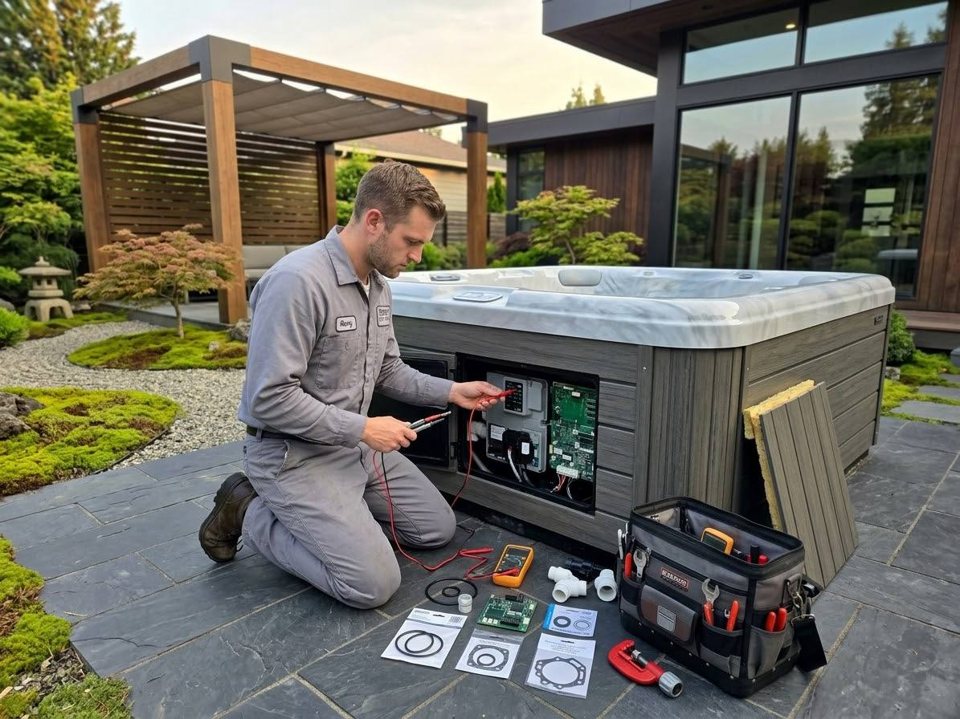
Water obeys gravity, not intuition: it runs the shell, follows a brace, and drops at the far corner, so the wet spot is the end of the story rather than the beginning. Chasing it backwards with towels teaches you nothing. Our method is to start bone-dry and let the leak reveal itself in order — unions at rest, then jets and manifolds under pump pressure.
Freeze-thaw does the writing around here. A fitting stressed in January opens in April when the tub is refilled and brought to temperature, which is why spring is our leak season and why the smallest crack shows only when warm.
What the symptom usually means
Level drops daily
Beyond evaporation, that is a gasket or a union relaxing. Which one is a question of watching, not guessing.
Wet only when jets run
A pressure-side joint that seals at rest and weeps under load. The sneakiest kind — and the most common.
One soaked corner
The exit point, almost never the source. We trace uphill before any foam is cut.
Sealer already tried
Sealer masks the trail. It sometimes buys a season; it always makes the eventual proper fix slower.
The procedure
- Bay dried completely before observation starts
- Static fill watched first, pump cycles second
- Insulation opened in targeted squares, then re-insulated
- Repair proven under pressure before the panel goes back
- Written figure once the source is identified